
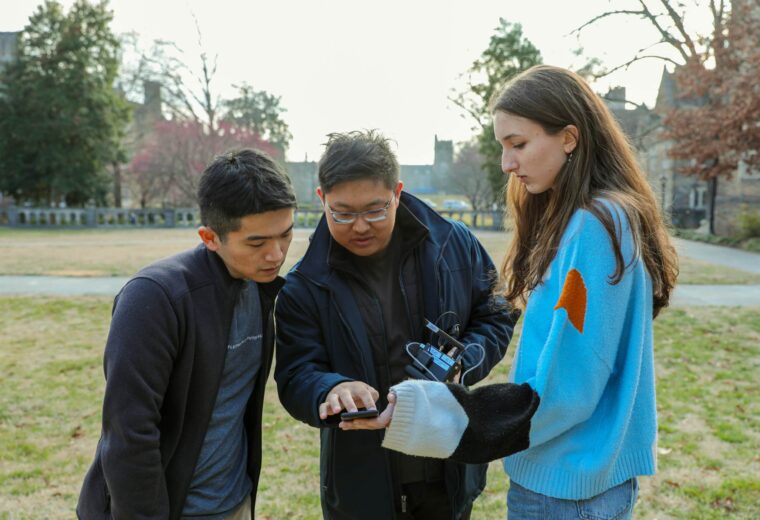
At the Edge of Wireless Innovation
More than three decades after Duke faculty helped develop modern wireless technology, the university remains at the forefront of its future.
From computing to devices, Duke Electrical and Computer Engineering is driving the future of technology in artificial intelligence, quantum computing, metamaterials, advanced communications and integrated systems.
From major research awards in quantum computing to groundbreaking work in artificial intelligence, semiconductors and metamaterials, Duke ECE continues to expand the boundaries of what technology can do.

Our faculty are advancing quantum systems that promise to transform secure communications and computation. We’re pioneering new approaches to edge computing that bring powerful AI models to small, energy-efficient devices. We’re developing new hardware and algorithms that make intelligent sensing and decision-making faster and more accessible. And we’re engineering novel metamaterials that manipulate light, sound and electromagnetic waves in unprecedented ways.
Through these achievements—alongside awards and successes in our education and outreach programs—Duke ECE continues to shape the technologies of the present and future. I invite you to explore this year’s highlights and celebrate the remarkable accomplishments of our faculty, students and staff.

Using Geometry to Push AI’s Boundaries

Exploring Quantum Systems with Neutral Atoms

Exploring Ultracold Atoms to Realize New States of Matter and Quantum Technologies

Developing Expertise in Data Management

Optimizing Computation Theory and Data Centers

Building High-Energy Space Electronics and Brain-Like AI Hardware

Advancing Algorithms and Learning Theory for Next‑Generation Quantum Systems

Perfecting Nanoscale Materials Fabrication for Quantum Systems

Protecting Privacy and Encryption Standards from AI

NSF CAREER Award

Clarivate Highly Cited List

ACM Distinguished Member

National Medal of Science

National Academy of Inventors Fellow

DARPA Director’s Fellowship

Ivy+ Provost Leadership Fellow, Institute on Inquiry, Equity and Leadership in the Academic Department

IEEE Edward J. McCluskey Technical Achievement Award and National Academy of Inventors Fellow

IEEE Fellow
Alfred P. Sloan Foundation Research Fellow in Physics

Optica Fellow

IEEE Fellow
Presidential Early Career Award for Scientists and Engineers (PECASE)

AAAS Fellow
NSF CAREER Award
More than three decades after Duke faculty helped develop modern wireless technology, the university remains at the forefront of its future.

Duke Engineering researchers demonstrate the first fully recyclable, sub-micrometer printed electronics.
Researchers build an “agentic system” of large language models that can solve complex design problems in a fraction of the time of skilled experts.
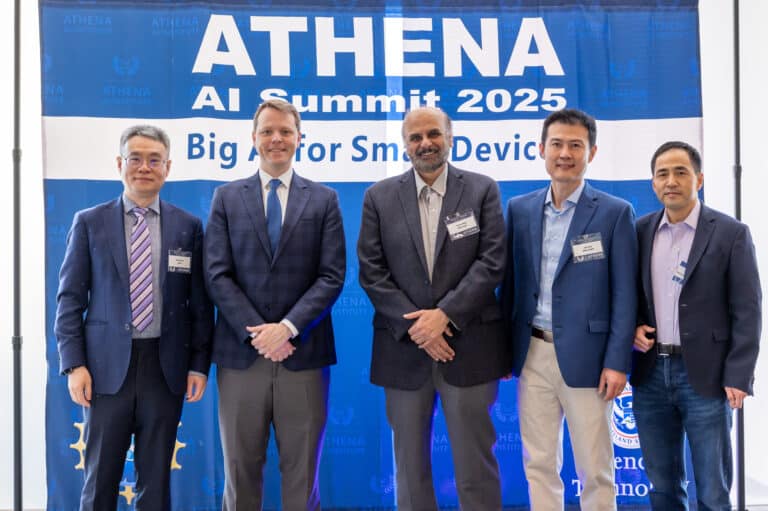
The AI Institute for Edge Computing Leveraging Next Generation Networks (Athena) hosted its inaugural Athena Summit to showcase Duke’s leadership in AI and edge computing to visitors from industry and government. Led by Yiran Chen, the institute is funded by the NSF and DHS and brings together a multidisciplinary team from 11 universities who collaborate on research, broadening participation in AI, and education and workforce development for the future.
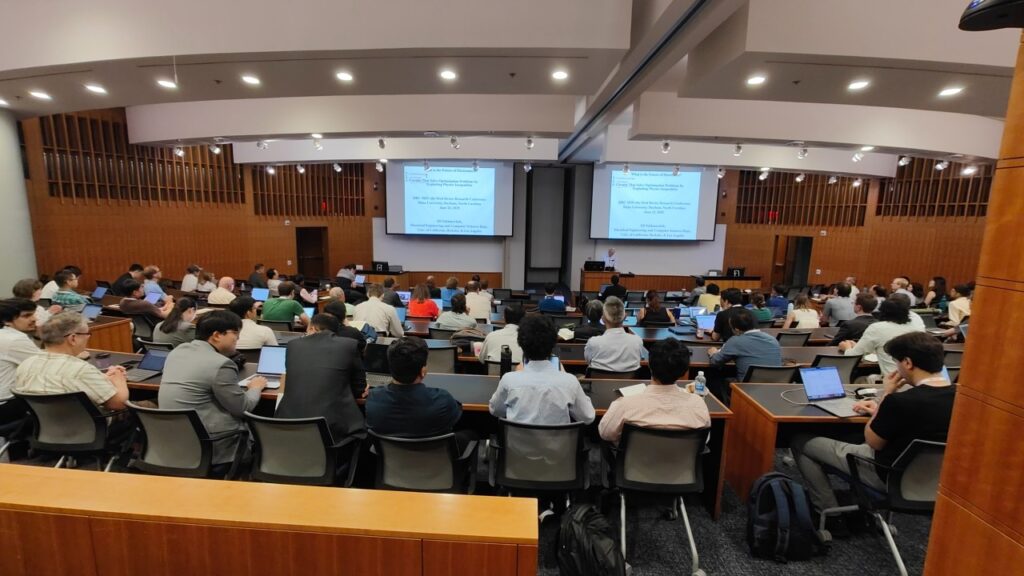
Duke ECE hosted the 83rd Device Research Conference, the world’s most prestigious and historic forum for device research innovation. Tania Roy served as general chair for the event, which brought more than 300 attendees to campus and featured 50 invited speakers, 100 contributed papers, two short courses and panels with industry and academia.

Startup built by three Duke Engineering undergraduates is acquired by industry-leading construction planning platform.
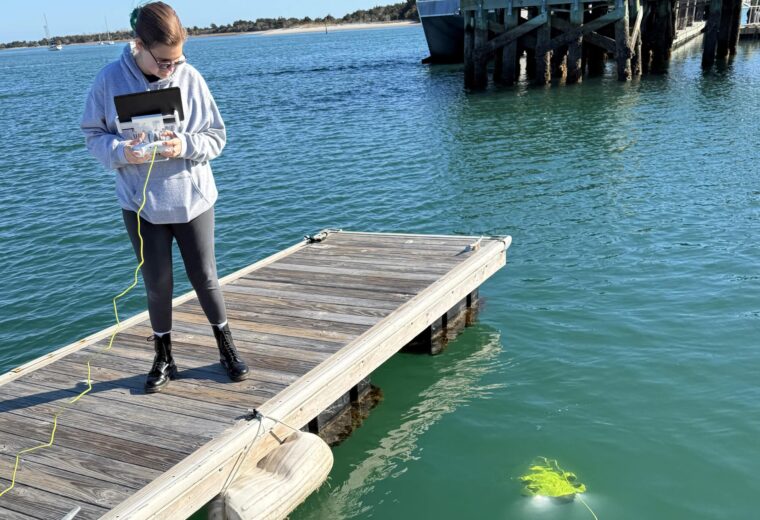
Design course at the Duke University Marine Lab provides an attractive alternative to semesters abroad with experiential travel opportunities and still attend basketball games on the weekend.

Every year, the fundamentals of electrical and computer engineering, a first-year ECE lab, introduces key engineering concepts like sensors, hardware and coding.