Trapping Light on Thermal Photodetectors Shatters Speed Records
Metasurfaces featuring tailored silver nanocubes could allow thermal photodetectors to approach speeds akin to traditional digital cameras.
Duke Engineering's "Character Forward Initiative" is helping to shape students' outlooks and perspectives beginning in EGR 101.
Rebecca Du, an MS in ECE student, talks about what sets Duke apart: world-class research spaces, beautiful architecture, and a close-knit community. Hear how Duke offers a balance of big-school resources and small-school connection for graduate students.
Patrick Pensabene, MEng '14, shares his experience in the ECE master's program at Duke University. A rigorous curriculum plus supportive faculty with industry connections opened the path to the exact career he wanted in high-performance computing.
Aaron Franklin shows that a common lab setup can inflate 2D transistor performance by up to five times, raising questions about how future chips are benchmarked.
Digital communications pioneer recognized for foundational contributions to technologies enabling billions of devices from early modems to modern smartphones.
Duke engineers show how a common device architecture used to test 2D transistors overstates up to sixfold their performance prospects in real-world devices.
Aaron Franklin studies nanomaterials as disruptive complements or replacements for conventional silicon technology.
Hai “Helen” Li studies neuromorphic computing and AI hardware from a design and computer architecture perspective.
Duke Quantum Center researchers use a neutral-atom platform to simulate unusual localization effects that could underpin robust quantum information storage.
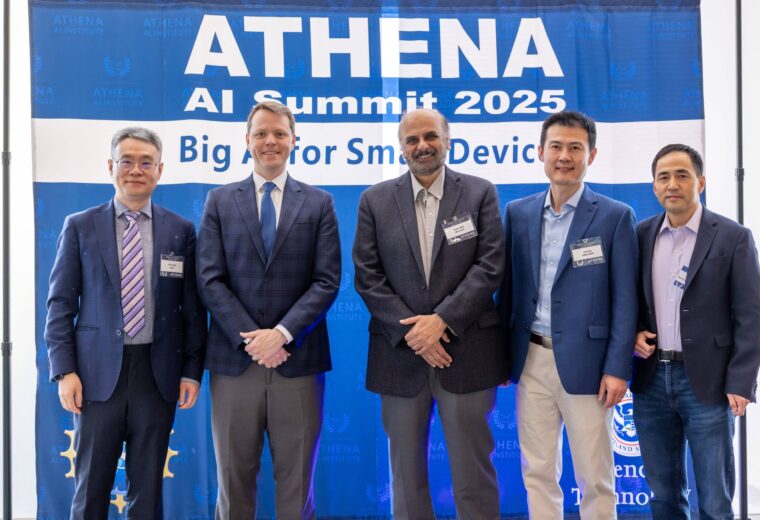
The Athena AI Institute brought together prominent stakeholders to further the global collaborations needed to scale edge AI.
Neil Gong joins other AI security experts in weighing in on whether or not it will be possible in the near future to launch a secure AI assistant that can navigate threats such as "prompt injection."