Build a strong foundation in the science behind the devices and circuits that make modern electronics possible through the ECE semiconductor technology master’s track. Gain exposure across areas such as nanoscale science, integrated circuits and quantum-related technologies, while learning from faculty at the cutting edge of nanoelectronics, sensors and advanced materials research.
Note: Courses are subject to change based on availability.
To earn a master’s in ECE focused on semiconductor technology (MS or MEng)
10
Courses
Build depth in semiconductor science, devices and circuits
SMIF Access
Apply coursework through hands-on research in advanced cleanroom and characterization facility
Customize Your Degree
Flexible pathways allow you to tailor your curriculum for industry or research
What is the Semiconductor Technology Master’s Track?
At Duke ECE, the Semiconductor Technology track prepares you to step right into semiconductor industry roles or advanced graduate research. You’ll build knowledge across semiconductor fundamentals, devices and circuits, then complement that foundation through hands-on research and close interaction with faculty.
Deep Technical Foundation: Rigorous coursework in nanoscale science, solid-state physics, devices and integrated circuits helps you build the technical depth employers and research programs value.
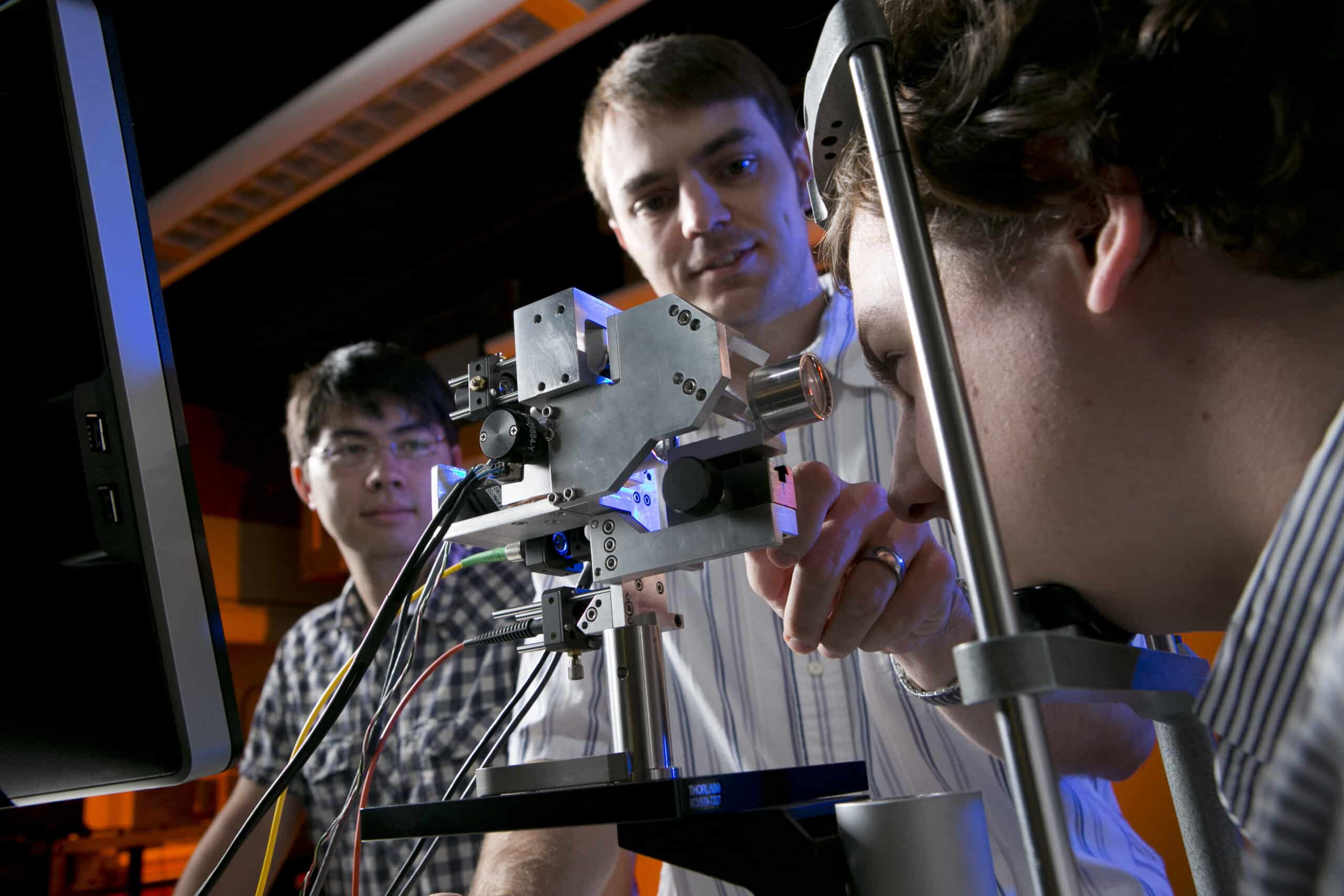
Accessible Hands-On Opportunities: Through independent study or faculty-guided projects, students can gain experience in labs working on semiconductor technology, adding practical skills. This track is effective for students who want to prepare for manufacturing and process engineering careers, as well as those seeking to pursue PhD studies.
An Eye on the Future: Duke’s faculty expertise spans the semiconductor landscape, from materials and devices to circuits and system-level design. Our faculty work at the frontier of semiconductor technology in areas such as low-dimensional nanomaterials, nanoscale transistors and neuromorphic devices, which helps our students prepare for what’s to come.
Shared Materials Instrumentation Facility (SMIF)
Duke’s semiconductor research is supported by the SMIF cleanroom and characterization lab, a key resource for experimental work in materials and device research.
Graduates must take a minimum of 10 required graduate level courses (30 credits) and the first-year seminar.
ECE 511 (Foundations of Nanoscale Science and Technology)
ECE 520 (Graduate Introduction to Quantum Engineering)
ECE 521 (Quantum Mechanics)
ECE 523 (Quantum Computing)
ECE 524 (Introduction to Solid-State Physics)
ECE 512 (Emerging Nanoelectronic Devices)
ECE 526 (Semiconductor Devices for Integrated Circuits)
ECE 533 (Biochip Engineering)
ECE 590 (Quantum Device Manufacturing)
ECE 528 (Nanoscale IC Chip Technology)
ECE 529 (Digital Integrated Circuits)
ECE 531 (Power Electronic Circuits for Energy Conversion)
ECE 532 (Analog Integrated Circuit Design)
ECE 539 (CMOS VLSI Design)
MS students choose three electives, and MEng students choose one elective from the following list:
Any other course in the semiconductor technology study track not already used to satisfy another requirement
ECE 899 (Independent Study) in a relevant topic with faculty agreement required (max 2)
Any course from other ECE master’s tracks
Any other graduate-level course with advisor approval
Ungraded research (3 credits for optional MS project, 6 credits for optional MS thesis)
ECE 701S (weekly seminar required for first-year master’s students)
MEng 540 (Management of High Tech Industries)
MEng 570 (Business Fundamentals for Engineers)
Internship (0 credits), typically completed in the summer between first and second years
MS students have three options to complete their requirements.
Coursework only (30 credits) with poster session
Coursework (27 credits) + capstone project (3 credits of ungraded research or independent study ECE 899)
Coursework (24 credits) + thesis (6 credits of ungraded research or independent study ECE 899)
Hear from Our Students
I chose Duke because I wanted a graduate program where I could combine strong technical training with meaningful hands-on research in semiconductor devices.
All Duke ECE master’s students have access to professional development support, faculty mentorship and career advising as they prepare for roles in industry or further graduate study. MEng students complete an industry internship and take core courses in management and business fundamentals designed to strengthen career readiness.
Strengthened by a historic investment from the family of Pierre R. Lamond, Duke ECE is home to a wide range of transformative research in semiconductors, nanoelectronics, and computer engineering: fields increasingly shaping how we live in a smarter society.
We have built a team of internationally recognized experts in artificial intelligence and machine learning—in fact, Duke ECE is said to be among the world’s top universities in AI/ML research. Our engineers urge computer hardware to higher levels of performance by efficiently allocating the computing resources that machine learning applications require, allowing us to harness the power of data to improve health care, enhance security and automation, and advance computer vision.
Cross-Disciplinary Connections
Duke also offers an interdisciplinary Master of Engineering in Photonics and Optical Sciences featuring coursework in both ECE and the Duke Department of Biomedical Engineering.
A semiconductor technology master’s can prepare you for roles in semiconductor manufacturing, devices and process engineering, consumer electronics and advanced electronics. Duke ECE graduates from this track have gone on to work at companies such as Apple, Intel, Texas Instruments, TSMC and Wolfspeed, or continue into PhD study and advanced research.
In Duke ECE’s semiconductor technology track, you’ll build skills in semiconductor science, solid-state physics, electronic devices, integrated circuits and nanoscale engineering. You can also gain hands-on experience through faculty-guided projects and access to Duke’s Shared Materials Instrumentation Facility, which supports experimental work in materials, devices and characterization.
A semiconductor engineering focus within an electrical engineering degree means you study the electronic materials, devices and circuits that make modern chips and electronics possible while still grounding your education in ECE. At Duke, this approach gives you both specialized semiconductor depth and broader electrical and computer engineering preparation, which can be valuable for careers in industry and for future graduate research.
Duke engineers show how a common device architecture used to test 2D transistors overstates up to sixfold their performance prospects in real-world devices.
Through pioneering neuromorphic computing research, Yiran Chen is developing brain-inspired hardware neurons that could lead to faster, smarter and more energy‑efficient AI.
This website uses cookies as well as similar tools and technologies to understand visitors' experiences. By continuing to use this website, you consent to Duke University's usage of cookies and similar technologies, in accordance with the Duke Privacy Statement.
Cookie Preferences
Manage your cookie preferences below:
Essential cookies enable basic functions and are necessary for the proper function of the website.
Name
Description
Duration
Cookie Preferences
This cookie is used to store the user's cookie consent preferences.