

Magnetic Memory: Laying the Foundations for Modern AI
Yiran Chen and Helen Li have won the A. Richard Newton Technical Impact Award for their foundational research on magnetic random access memory (MRAM).
Strengthened by a historic investment from the family of Pierre R. Lamond, Duke ECE is home to a wide range of transformative research in semiconductors, nanoelectronics, and computer engineering: fields increasingly shaping how we live in a smarter society.
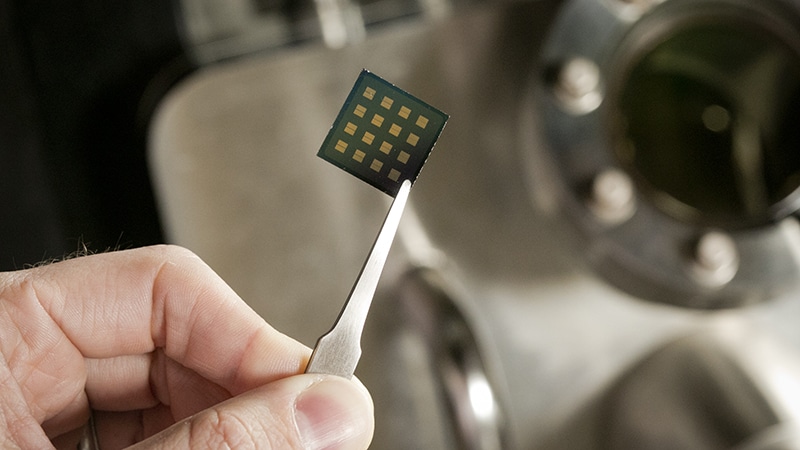
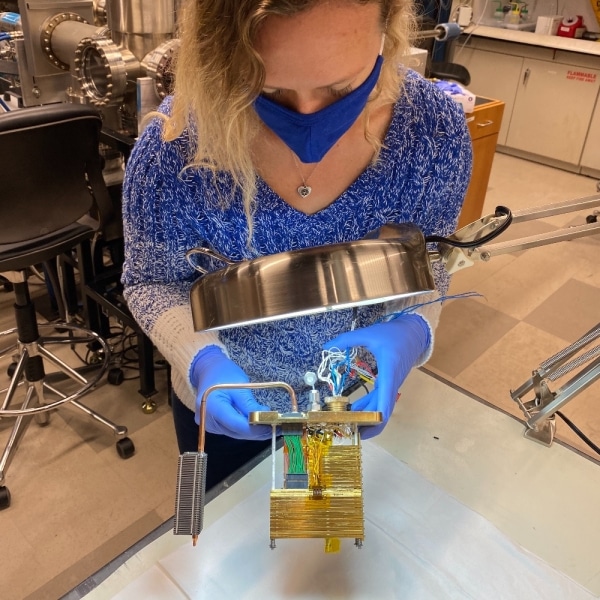
Structuring materials and particles at the tiniest of scales can imbue them with unique electronic, optical, or mechanical properties—engineers in Duke ECE are harnessing these attributes to enable transformative applications, from neuromorphic computing to environmentally friendly printed electronics. We are also working to create self-assembling electronic devices, and exploring the potential of novel electronic materials to enable next-generation chips, high-performance transistors, solar cells, photodetectors, and more.
Yiran Chen and Helen Li have won the A. Richard Newton Technical Impact Award for their foundational research on magnetic random access memory (MRAM).

Researchers Tania Roy and Sanjeev Chauhan will take their retina-inspired semiconductor startup, Synapse Semiconductor, to Y Combinator this summer.

Award-winning publication provides a blueprint for chip design companies to train machine learning models that help detect lithography hotspot patterns in IC layouts before fabrication while protecting proprietary layout data.

Senior Associate Dean, Edmund T. Pratt, Jr. Distinguished Professor of ECE

Hogg Family Director of Engineering Management & Entrepreneurship, Professor of ECE

J. A. Jones Distinguished Professor of Electrical and Computer Engineering

Associate Professor of Electrical and Computer Engineering

Associate Dean for Community-Based Innovation, Professor of ECE

Assistant Professor of Electrical and Computer Engineering
Explore additional specialty research areas in Duke ECE and throughout the Pratt School of Engineering.


