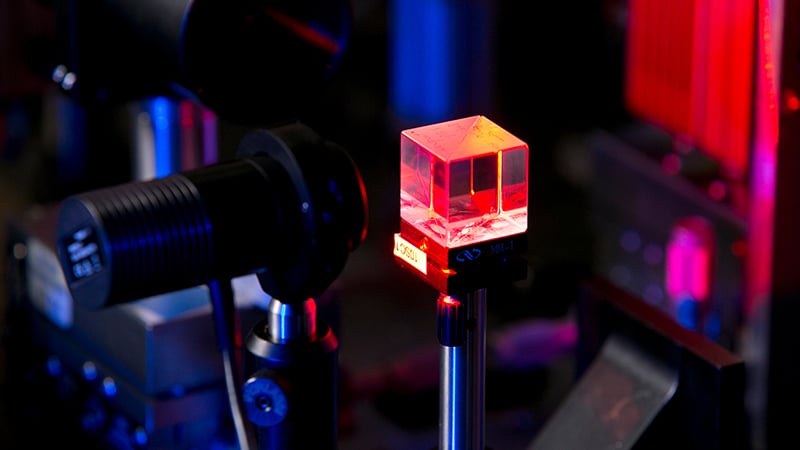
Study both the software and hardware behind quantum information systems through the ECE quantum software & hardware master’s track. Our students, who learn from faculty building in-house quantum computers, gain a strong foundation in how these systems are programmed, controlled and engineered.
Note: Courses are subject to change based on availability.
To earn a master’s in ECE focused on quantum software & hardware (MS or MEng)
10
Courses
Build depth in quantum software, quantum hardware and computer engineering
Major Research Hub
Learn under researchers at Duke Quantum Center’s interdisciplinary ecosystem
Customize Your Degree
Flexible pathways allow you to tailor your curriculum for industry or research
What is the Quantum Software & Hardware Track?
Duke’s quantum software and hardware master’s track gives students a strong foundation in quantum information systems. The track teaches students how quantum computers are built, controlled and applied. Students graduate with focused technical training and a clearer path into a fast-growing field that needs people who understand both quantum principles and engineering practice.
Quantum-Focused Coursework: Students take specialized courses in areas such as quantum error correction and quantum engineering with atoms and ions.
Learn in an Engineering Environment: At Duke ECE, students have access to software, hardware and systems perspectives that are essential to building real quantum technologies.
Connected to Duke Quantum Center: Students benefit from Duke’s broader quantum ecosystem that includes researchers across the university.
Quantum Software & Hardware Track Curriculum
Graduates must take a minimum of 10 required graduate level courses (30 credits) and the first-year seminar.
ECE 520 (Graduate Introduction to Quantum Engineering)
ECE 521 (Quantum Mechanics)
ECE 523 (Quantum Computing)
ECE 623 (Quantum Information Theory)
ECE 551D* (Programming, Data Structures, and Algorithms in C++) or ECE 751D (Adv. Programming, Data Structures, and Algorithms in C++)
ECE 568 (Engineering Robust Server Software)
ECE 552 (Advanced Computer Architecture I)
ECE 580 (Introduction to Machine Learning)
ECE 586D (Vector Space Methods with Applications)
ECE 650 (Systems Programming and Engineering)
ECE 651 (Software Engineering)
ECE 652 (Advanced Computer Architecture II)
ECE 512 (Emerging Nanoelectronic Devices)
ECE 522 (Quantum Engineering with Atoms)
ECE 524 (Introduction to Solid-State Physics)
ECE 541 (Advanced Optics)
ECE 545 (Foundations of Nanoelectronics & Nanophotonics)
ECE 546 (Optoelectronic Devices)
ECE 554 (Fault-Tolerant and Testable Computer Systems)
ECE 559 (Advanced Digital System Design)
ECE 567 (Cyber-Physical System Design)
ECE 571 (Electromagnetic Theory)
ECE 590 (Quantum Hardware)
ECE 590 (Nonlinear Optics)
ECE 590 (Quantum Simulation)
Any core quantum course if not already used to satisfy other requirements
ECE 590 (Quantum Hardware) if not already taken above
ECE 522 (Quantum Engineering with Atoms) if not already taken above
ECE 590 (Quantum Simulation)
ECE 621 (Quantum Error Correction)
ECE 722 (Quantum Electronics)
MS students choose three electives, and MEng students choose one elective from the following list:
Any other course in the quantum software & hardware study track not already used to satisfy another requirement
ECE 899 (Independent Study) in a relevant topic with faculty agreement required (max 2)
ECE 581 (Random Signals & Noise)
Any graduate ECE course if not already taken to satisfy another requirement
Any other graduate-level course with advisor approval
Ungraded research (3 credits for optional MS project, 6 credits for optional MS thesis)
ECE 701S (weekly seminar required for first-year master’s students)
MEng 540 (Management of High Tech Industries)
MEng 570 (Business Fundamentals for Engineers)
Internship (0 credits), typically completed in the summer between first and second years
MS students have three options to complete their requirements.
Coursework only (30 credits) with poster session
Coursework (27 credits) + capstone project (3 credits of ungraded research or independent study ECE 899)
Coursework (24 credits) + thesis (6 credits of ungraded research or independent study ECE 899)
Hear from Our Students
A big reason I chose Duke was because of the specific tracks you could choose to complete and customize your degree. The quantum computing track offered so many interesting courses that I was very excited to take! I specifically like that it requires you to take both hardware focused and software focused courses, ensuring you have knowledge across the computing stack.
June VanlerbergheMS ECE (Quantum Software & Hardware), 2026
The master’s program at Duke gave me a perfect mix of the quantum, software and business skills that I needed to jump right into industry and contribute on my first day of the job.
Grant EberleMEng ECE (Quantum Software & Hardware), 2023, Software Engineer at IonQ
Careers in Quantum Computing
All Duke ECE master’s students have access to professional development support, faculty mentorship and career advising as they prepare for roles in industry or further graduate study. MEng students complete an industry internship and take core courses in management and business fundamentals designed to strengthen career readiness.
Software-Tailored Architecture for Quantum Codesign
Duke Quantum Computing Research
With $80+ million in funding from IARPA, ARO, NSF and DOE to date, Duke ECE’s internationally recognized quantum computing team—part of the Duke Quantum Center—is replacing the bits of traditional computers with trapped ion qubits, which exist in multiple states at once. These powerful new systems have the potential to perform multitudes of computations in quantum superposition, enabling algorithmic shortcuts for blazing-fast computation. The future holds promise for applications in cybersecurity, AI, and modeling complex biological, chemical, pharmacological, environmental and financial systems. Spinoff IonQ has raised $77M in investor funding to date and has built two of the most accurate quantum computers in existence.
A quantum software and hardware master’s can prepare you for roles in quantum computing, advanced technology and research environments. Duke ECE graduates from this track have gone on to positions such as software engineer and research scientist at organizations including IonQ, IBM, Quantinuum, QuEra and Maybell Quantum, as well as in national laboratories and research universities.
In Duke ECE’s quantum software and hardware track, you’ll build skills in quantum information systems, quantum computing, quantum hardware and computer engineering. The curriculum gives you exposure to both the software and hardware sides of the field, helping you understand how quantum systems are programmed, controlled and engineered.
A quantum software and hardware degree is focused on the engineering and computing side of quantum technology, including how quantum systems are built, controlled and used in practice. Although a physics degree may emphasize the underlying science and theory, Duke ECE’s track is designed for students who want to work across quantum hardware, software and systems in real technology and research settings.
Team led by Duke Quantum Center advances toward designing a powerful 256-qubit quantum computer as part of a major NSF initiative for quantum technology.
New $2.66 million grant from the National Science Foundation will support the construction of a 96-qubit quantum computer to enable future advances in the field.
Duke Quantum Center researchers use a neutral-atom platform to simulate unusual localization effects that could underpin robust quantum information storage.
This website uses cookies as well as similar tools and technologies to understand visitors' experiences. By continuing to use this website, you consent to Duke University's usage of cookies and similar technologies, in accordance with the Duke Privacy Statement.
Cookie Preferences
Manage your cookie preferences below:
Essential cookies enable basic functions and are necessary for the proper function of the website.
Name
Description
Duration
Cookie Preferences
This cookie is used to store the user's cookie consent preferences.