Revealing Security Risks to Publicly Accessible Machine-learning Models
Research co-authored by Michael Reiter has received the 2026 Test of Time award from the USENIX Security Symposium.

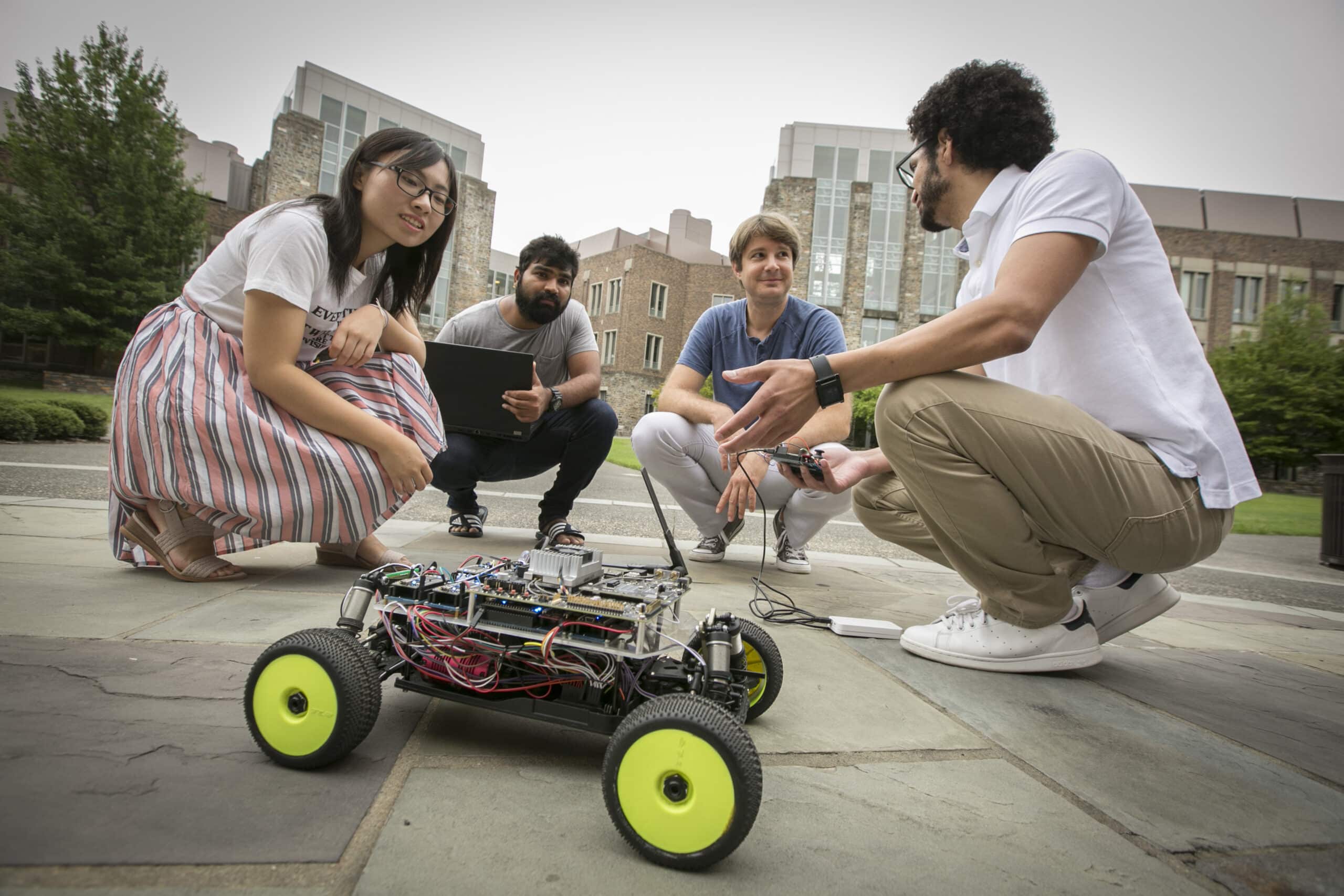
Close collaborations with industry and government partners drive Duke ECE’s work to secure systems in the cloud, on the ground and in the air. Our faculty includes internationally recognized specialists in human-machine interaction, whose expertise is regularly sought by policymakers and industry to inform safety considerations for self-driving cars and other autonomous systems, and experts in resilient integrated circuit/system design and software reliability. Among our many research endeavors are machine learning techniques to predict security vulnerabilities, efficient countermeasures that enable embedded systems and microfluidic biochips to detect and resist attacks, and breakthroughs that secure machine learning hardware and AI accelerators. Our faculty leads Air Force University Centers of Excellence on assured autonomy and communications networks in contested environments.

Research co-authored by Michael Reiter has received the 2026 Test of Time award from the USENIX Security Symposium.

Professor Neil Gong and other scholars have been issuing warnings about the security vulnerabilities of AI agents for a while.

Duke ECE’s Maria Gorlatova earns a DARPA Director’s Fellowship to advance research that makes augmented reality safer for soldiers and everyday users.

Nortel Networks Assistant Professor of Electrical and Computer Engineering

Sternberg Family Associate Professor of Electrical and Computer Engineering

Chair of Electrical and Computer Engineering, Marie Foote Reel E’46 Distinguished Professor

Director of Master’s Studies, Professor in the Department of ECE

James B. Duke Distinguished Professor of Computer Science
Explore additional specialty research areas in Duke ECE and throughout the Pratt School of Engineering.