

David Smith Selected for NASA NIAC Fellowship
Award will support the pursuit of robotically assembled metamaterials in space for radar systems enabling long-range situational awareness.
Duke’s Electrical and Computer Engineering research enables creative, applicable solutions to pressing challenges in human health, security, and automation, and new strides in fundamental scientific exploration and discovery. Government and industry organizations are valuable partners at Duke ECE, and our entrepreneurial spirit manifests itself in a growing portfolio of companies spun off from our research.
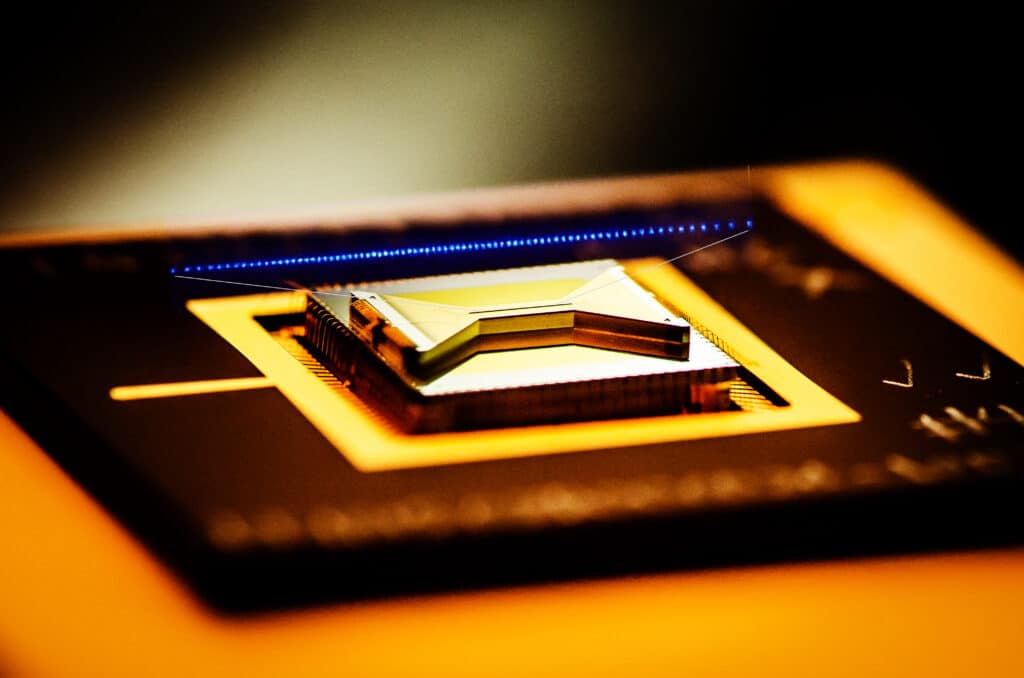
Our faculty are nationally and internationally recognized for research in areas including:

We have built a team of internationally recognized experts in artificial intelligence and machine learning—in fact, Duke ECE is said to be among the world’s top universities in AI/ML research.

Our faculty members demonstrated the world’s first negative refractive index metamaterial in 2000, and in 2006 a Duke ECE engineer invented a metamaterial “invisibility cloak” that renders objects undetectable at microwave frequencies.
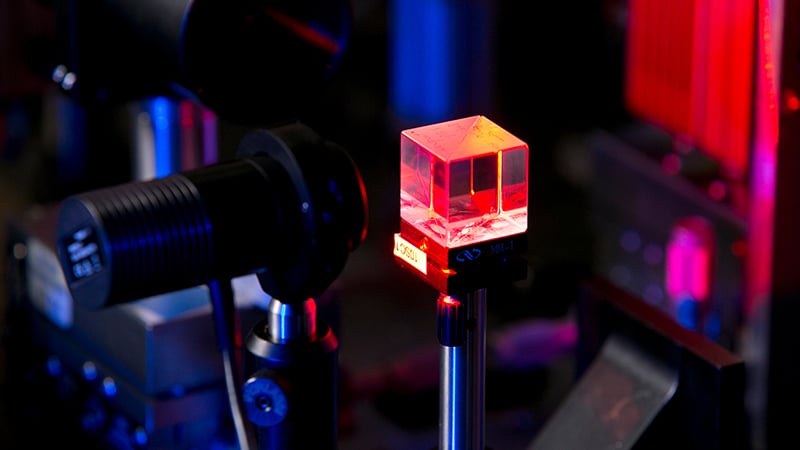
Our internationally recognized quantum computing team—part of the Duke Quantum Center—is replacing the bits of traditional computers with trapped ion qubits, which exist in multiple states at once.
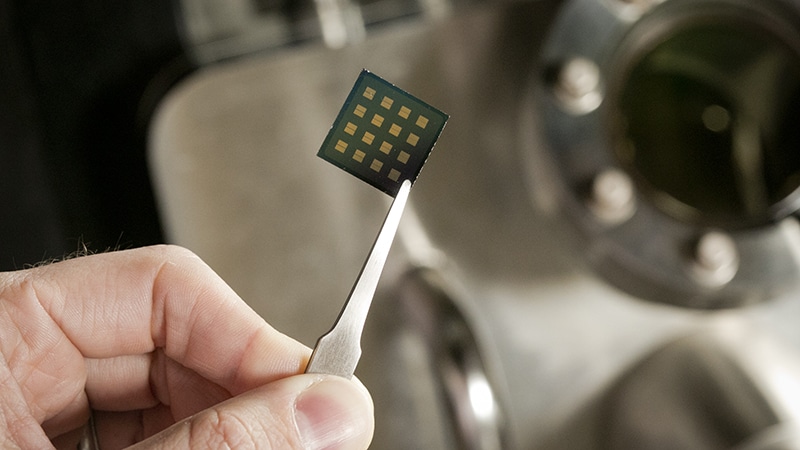
We are working to create self-assembling electronic devices, and exploring the potential of novel electronic materials to enable next-generation transistors, neuromorphic computing, solar cells, photodetectors, and more.

We’re developing novel approaches to gathering and analyzing information to make our world safer and more secure, and healthcare applications faster and more efficient.

Close collaborations with industry and government partners drive our work to secure systems in the Cloud, on the ground and in the air.
Award will support the pursuit of robotically assembled metamaterials in space for radar systems enabling long-range situational awareness.
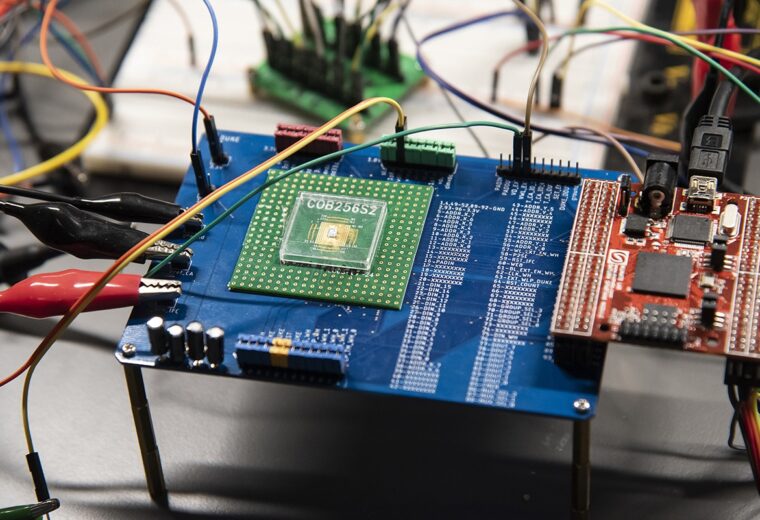
Duke engineers are leading a Phase 1 Genesis project funded by the Department of Energy to develop robotic AI processing hardware 10x faster and 100x more efficient than today’s top performers.

An academic-industry collaboration identifies 1% of resumes in a 200,000 sample across multiple sectors as containing concealed instructions meant to exploit AI systems.
In this Q&A series, Duke ECE faculty members discuss their work in semiconductor‑related research and how they are making an impact in the field.

Aaron Franklin studies nanomaterials as disruptive complements or replacements for conventional silicon technology.

Hai “Helen” Li studies neuromorphic computing and AI hardware from a design and computer architecture perspective.

Haozhe “Harry” Wang pioneers atomic-scale semiconductor manufacturing to push electronics beyond silicon.

Tania Roy studies novel semiconductor materials and devices to advance energy-efficient computing and edge AI.

Yiran Chen develops brain-inspired semiconductor hardware to enable faster, greener AI at the edge.